Introduction
Single-serve coffee makers have fundamentally changed how many people approach their morning routine. For households where coffee preferences vary—or where one person is the only coffee drinker—the appeal is straightforward. Instead of brewing a full pot that sits warming on the burner, you can prepare an individual cup in minutes, tailored to your specific taste.
The Keurig K-Slim represents a particular approach to this market segment. It’s designed for people who value both functionality and space efficiency, combining compact dimensions with the familiar K-Cup pod brewing system. Understanding how this machine works, what it offers, and whether it matches your household’s needs requires looking beyond surface-level specifications.
This article examines the K-Slim’s practical applications, features, design philosophy, and the broader context of how it fits into the current single-serve coffee landscape. Whether you’re replacing an aging machine, downsizing your kitchen setup, or exploring single-serve brewing for the first time, this guide provides the information needed to make an informed decision.
Understanding Single-Serve Coffee Technology
Before diving into the specifics of the K-Slim, it’s helpful to understand what single-serve coffee brewing means and why it appeals to different household types.
Single-serve machines brew individual cups rather than pots. This approach offers flexibility—different household members can make coffee at different times with different flavoring preferences—without the waste associated with unused coffee sitting on a warming plate. For environmental considerations, this translates to brewing only what you’ll actually drink.
The K-Cup pod system, which Keurig pioneered, uses small sealed pods containing pre-measured ground coffee and a filter. You insert the pod, close the brewing chamber, and the machine punctures it, forcing hot water through the grounds and into your cup. This methodology eliminates the need for separate filters and reduces variables in the brewing process, since each pod contains a consistent coffee amount.
Over the past decade, the single-serve market has become more sophisticated. Machines now offer variable brew sizes, adjustable water temperatures, and different brewing technologies designed to improve flavor extraction. The K-Slim incorporates some of these refinements while maintaining simplicity in design and operation.
Key Features and Design Elements
Multistream Technology
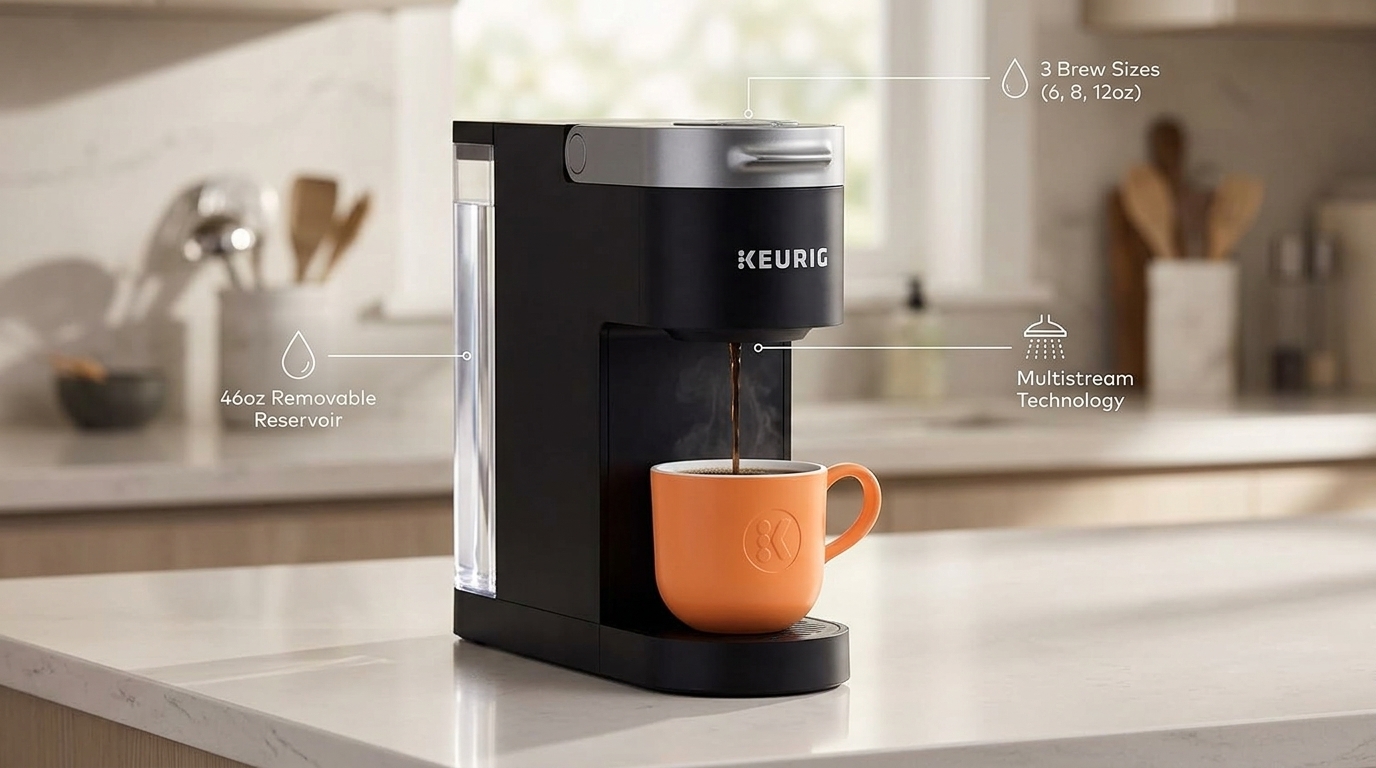
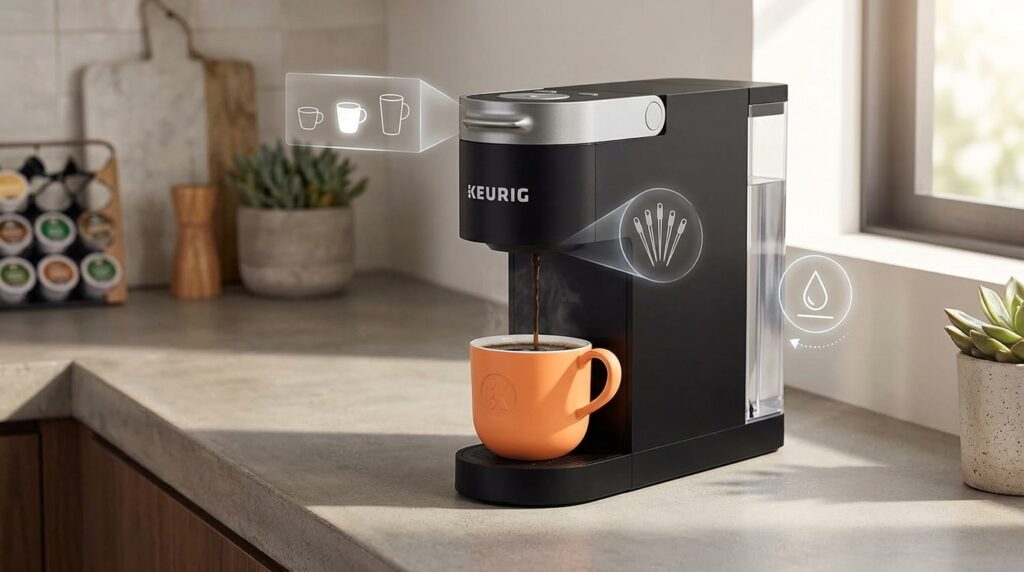
The K-Slim uses what Keurig calls Multistream technology, which represents an evolution in how water is delivered to the coffee grounds. Rather than a single stream of water hitting the pod, this system distributes water across multiple points within the brewing chamber.
The practical significance of this technology relates to extraction. Coffee flavor develops through a chemical process where hot water dissolves soluble compounds from the grounds. Uniform water distribution helps ensure consistent saturation across all the grounds, potentially improving flavor complexity and reducing thin or weak-tasting cups. In simpler machines, water sometimes floods one area while other portions remain under-saturated, leading to uneven extraction.
From a user perspective, Multistream technology works without requiring any special operation steps. You follow the same basic procedure: insert a pod, select your brew size, and press brew. The improved water distribution happens internally.
Brew Size Flexibility
The K-Slim offers three brewing options, typically ranging from smaller (6-8 ounces), standard (about 10 ounces), and larger (11-12 ounces) sizes. This flexibility addresses a real household need—not everyone drinks the same volume of coffee.
Someone who prefers a quick morning espresso-style shot differs from a person who settles in with a full mug. Office workers preparing a beverage before a commute might want something different than someone working from home. Over time, preferences also shift; some days call for less caffeine, while others warrant a fuller cup.
The ability to adjust without brewing extra coffee or using partial pods removes friction from the brewing decision.
The 46-Ounce Removable Reservoir
The water reservoir holds 46 ounces, which translates to roughly 5-6 cups of brewed coffee before refilling is necessary. This size represents a middle ground between ultra-compact machines and larger brewers.
Removability matters practically. You can detach the reservoir for refilling at the sink, rather than pouring water into a small opening while the machine sits on the counter. This design choice reduces spills and makes cleaning easier. Removable reservoirs also simplify descaling procedures, which are necessary periodically to maintain machine performance.
The 46-ounce capacity suits individuals and small households well. A solo coffee drinker may refill once every couple of days, while a two-person household might refill daily. Larger families or offices would find themselves refilling more frequently.
Physical Design and Footprint
The “K-Slim” name reflects the machine’s spatial efficiency. Traditional drip coffee makers and larger single-serve brewers occupy significant counter space. This model prioritizes a slender profile, making it suitable for compact kitchens, apartment counters, dorm rooms, or office spaces where real estate is limited.
A space-conscious design doesn’t mean sacrificing essential functionality. The machine still includes the components necessary for brewing—heating element, water distribution system, and collection tray—but arranges them vertically rather than sprawling horizontally.
The black finish is a neutral aesthetic choice that complements various kitchen styles without imposing a particular design direction. It’s neither particularly trendy nor dated, making it unlikely to clash with existing décor.
How It Can Be Used
Morning Routine Optimization
For many users, the primary application is morning coffee preparation. A single-serve machine can have your beverage ready in two minutes or less, faster than brewing a full pot. If different household members prefer different coffee types—one person wants black coffee, another wants a flavored variety—each can prepare exactly what they want without compromise.
Office and Workspace Applications
Individual workspaces increasingly use single-serve brewers. A workplace coffee station can stock multiple K-Cup varieties, allowing employees to choose their preferred roast, flavor, and caffeine level. This approach works well in small offices or break rooms where a full commercial coffee system seems excessive but providing only drip coffee limits choice.
Flexible Caffeine Timing
Some people benefit from multiple smaller cups throughout the day rather than one large morning cup. The K-Slim’s quick brew time and relatively small footprint make this practical. You might have one cup with breakfast, another mid-morning, and potentially another in the afternoon, without the commitment of brewing a full pot each time.
Guest Accommodation
Households that regularly host guests appreciate the flexibility of single-serve brewing. Visitors can choose from available K-Cup varieties rather than everyone getting whatever brew is already prepared. This proves particularly useful when guests have specific preferences or dietary restrictions.
Beverage Variety
K-Cup availability extends well beyond traditional coffee. The pods include various roasts, flavored options, decaffeinated varieties, and even non-coffee options like tea and hot chocolate. A single machine can serve multiple beverage preferences without maintaining separate brewers for coffee, tea, and other drinks.
Who This Machine May Be Suitable For
Solo Coffee Drinkers
Someone who lives alone and enjoys coffee represents an ideal use case. You avoid the waste of brewing more than you’ll consume, brew only when you want it, and can experiment with different varieties.
Small Households with Varying Preferences
Couples or small families where coffee tastes differ benefit from the flexibility. One partner might prefer a darker roast while the other likes something lighter; the machine accommodates both without negotiation.
Space-Limited Living Situations
Apartment dwellers, dorm residents, and anyone with modest kitchen space appreciate a compact footprint. The slender design fits where traditional coffee makers wouldn’t.
Remote Workers
People working from home might appreciate the ability to brew fresh coffee multiple times throughout the day without the commitment of a full pot. The quick brew time fits well into work breaks.
Offices and Break Rooms
Small to medium workplaces can provide employee coffee service efficiently using a single-serve system. The variety of available pods means different preferences get accommodated.
Budget-Conscious Buyers
After initial purchase, ongoing costs depend on K-Cup variety choices. Some pods cost significantly less than specialty coffee shop beverages, making home brewing economical for regular consumers.
Environmentally-Conscious Users Exploring Single-Serve
While K-Cup pods have environmental considerations, brewing only what you consume avoids the waste of pot coffee that remains undrunk. For those wanting to reduce waste compared to full-pot brewing, this represents a step forward (though pod recycling and compostable options would be the ideal solution).
Important Considerations Before Purchase
K-Cup Dependency
This machine exclusively brews using K-Cup pods. If you prefer whole-bean coffee ground to your specifications, this isn’t suitable. You’re dependent on available pod varieties and cannot customize grind size or coffee origin to the same degree as other brewing methods.
Pod Costs and Availability
While K-Cups are widely available, the cost per serving differs from brewing traditional coffee. Depending on the pods you choose, cost per cup could range from reasonable to considerably more than drip coffee. You’ll want to compare against whatever your current brewing method costs.
Water Quality Matters
Single-serve machines are particularly sensitive to water quality. Hard water leaves mineral deposits in heating elements and channels. If your tap water is hard, regular descaling becomes essential to maintain performance and prevent the machine from failing prematurely. Using filtered water can reduce this burden.
Brewing Temperature Consistency
Single-serve pods brew at one temperature setting. If you’re particular about water temperature for different coffee types, or want the precision that some premium coffee methods offer, this uniformity might feel limiting. The machine makes brewing convenient, not customizable in the way methods like pour-over offer.
Machine Longevity
The typical lifespan of a single-serve brewer is 5-7 years depending on water quality and usage frequency. This should factor into your cost calculation. If calculated over use, the per-cup investment includes amortizing the machine itself.
Noise Level
Single-serve brewers are generally noisier than passive brewing methods. If you’re brewing early morning in a shared living space or apartment, this could matter.
Limited Brewing for Groups
If you regularly brew coffee for multiple people simultaneously, this isn’t optimal. You’d make individual cups sequentially rather than one large batch. For households with this need, traditional machines prove more practical.
Comparing Single-Serve Options
The single-serve market includes various technologies and designs. Understanding how the K-Slim compares to general categories helps contextualize its position.
K-Cup Pod Systems
Keurig owns the largest share of the pod-based market. Other manufacturers produce compatible pods, which means users have choices. The K-Slim uses this established system, providing access to hundreds of pod varieties from multiple producers. This wide selection is an advantage if pod variety matters to your choice-making.
Alternative Pod Systems
Nespresso and some other manufacturers use proprietary pods specific to their machines. These systems often emphasize espresso-style brewing. If you’re specifically interested in espresso-style beverages, these represent alternatives. However, pod availability is more limited than K-Cup’s broad ecosystem.
Manual Brewing Methods
Pour-over, French press, and Aeropress methods require more hands-on involvement but offer greater control over variables. Coffee enthusiasts often prefer these methods because grind size, water temperature, and timing all affect the outcome. If control and coffee customization are priorities, manual methods deliver this at lower equipment cost, though they’re slower and require more technique.
Drip Coffee Machines
Traditional programmable drip brewers still hold a significant market share. They brew larger quantities (typically 12 cups) at lower per-cup cost. If you regularly brew for multiple people or prefer batch brewing, drip machines remain practical. The trade-off is convenience—you commit to a full pot regardless of consumption, and the machine occupies more space.
Espresso Machines
Dedicated espresso machines range from affordable manual models to sophisticated semi-automatic and automatic systems. They deliver the concentrated shot-based drinks that espresso enables. These require more skill and maintenance than pod systems, but enthusiasts value the control and quality possible with proper technique.
The K-Slim’s positioning within this landscape reflects a priority on convenience, space efficiency, and simplicity over maximum customization or lowest per-cup cost.
Technical Specifications and Practical Details
Brewing Speed
The K-Slim typically completes a brew cycle in about 60-90 seconds from button press to finished cup. This speed factors in heating water to the correct temperature and the extraction process itself. For someone accustomed to waiting for a drip machine or French press, this quick turnaround feels notably faster.
Water Heating
The machine uses an internal heating element to warm water. Unlike some premium models with pre-warming and precise temperature control, the K-Slim uses standard heating. For standard coffee pods, this is adequate; some specialty pods might perform differently with more precise temperature control.
Reservoir Water Level Indicator
Most K-Slim models include some form of water level indicator, helping users avoid attempting to brew with insufficient water. This practical feature prevents frustration and machine strain.
Brew Strength Control
Some K-Slim models include a brew strength option, allowing you to adjust how concentrated the final cup is. This doesn’t change brewing temperature but rather affects water saturation time or intensity. This feature, when available, provides useful flexibility for people who prefer stronger or milder coffee.
Drip Tray Capacity
A removable drip tray prevents water spillage on your counter. Understanding its capacity matters if you’re brewing larger cup sizes—some machines require frequent tray emptying while others hold significantly more. This is worth checking in specifications for your specific use pattern.
Maintenance and Longevity
Regular Cleaning
Rinsing the removable components (water reservoir, drip tray, and brew basket, if applicable) with warm water keeps the machine hygienic. Many users establish a weekly cleaning routine.
Descaling Schedule
Hard water mineral buildup is the primary threat to machine longevity. Descaling—using a descaling solution to remove these deposits—should happen every 3-6 months depending on your water hardness. Keurig provides descaling solutions specifically designed for their machines, and the process typically takes 30-45 minutes.
Puncture Needle Maintenance
The needle that pierces K-Cups can occasionally become clogged. If you notice weak brewing or incomplete pod penetration, cleaning this needle (Keurig provides instructions) usually resolves the issue. This is preventative maintenance rather than a complicated repair.
Typical Lifespan
With regular maintenance and typical usage (1-3 cups daily), expect 5-7 years of reliable operation. Some machines last longer; others may require replacement earlier depending on water quality and care.
Cost Considerations
Initial Investment
The K-Slim represents a modest upfront cost compared to many kitchen appliances. It’s more affordable than premium single-serve systems or commercial-quality machines.
Ongoing Pod Expenses
Cost per cup depends on pod selection. Budget options might cost $0.50-0.70 per pod, while premium varieties could run $1.00 or more. Multiply by your daily consumption to understand monthly expenses. For someone drinking 2-3 cups daily, annual pod costs could range from $400-1,000 depending on choices.
Comparison to Other Methods
For perspective, specialty coffee shop beverages typically cost $4-6 each. A home single-serve pod at $0.70 represents considerable savings if it replaces cafe visits. Compared to drip coffee brewed at home (costing perhaps $0.15-0.25 per cup), pod brewing is more expensive per cup but offers more convenience and control.
Electricity Costs
Single-serve brewers consume modest electricity. The heating element runs briefly for each brew. Annual electricity costs are typically under $20 for most household usage patterns.
Frequently Asked Questions
Can I use non-Keurig compatible pods?
The K-Slim works with standard K-Cup pods from any manufacturer, not exclusively Keurig brand pods. Many third-party manufacturers produce compatible pods, which expands your beverage options and potentially reduces costs.
What if my water is very hard?
Hard water requires more frequent descaling—potentially every 2-3 months instead of 4-6. Using filtered water (pitcher or faucet filter) reduces mineral content and decreases descaling frequency. Some users find this investment worthwhile to extend machine life and reduce maintenance.
Can I brew larger quantities for multiple people?
Technically, you can brew multiple individual cups sequentially, but this isn’t efficient if you regularly need to prepare beverages for several people at once. Traditional brewers remain better suited for that need.
Are there energy-saving features?
Most K-Slim models include automatic shut-off after a period of inactivity (typically 30-60 minutes), which reduces electricity waste. This helps if you sometimes forget to turn the machine off manually.
How does the machine handle decaf pods?
Decaf K-Cups brew identically to regular pods; the machine makes no distinction. This makes switching between caffeinated and decaffeinated coffee straightforward—just insert whichever pod you prefer.
What if a pod doesn’t puncture properly?
Occasionally, a pod might not pierce completely, resulting in weak coffee or no brew. Cleaning the needle mechanism, ensuring pods are inserted correctly, and checking that the brew head closes completely usually resolves this. It’s rare but worth knowing how to address.
Can I brew hot water without coffee?
Yes. Some users appreciate this feature for preparing tea, hot chocolate, or soup. Simply run a brew cycle without inserting a pod to dispense hot water.
Does the machine require a filter?
No separate filter is needed—the K-Cup pod contains its own filter material. This eliminates the need to purchase, store, and dispose of paper filters.
How often should I replace the machine?
With proper maintenance, expect reliable operation for 5-7 years. Some machines last longer; others may develop issues earlier. When repairs become frequent or the machine simply stops working, replacement becomes more practical than repair.
The Practical Reality of Single-Serve Brewing
Single-serve machines have fundamentally changed coffee consumption patterns for many households. They’ve made the option of quick, individual beverages readily available without the commitment full-pot brewing requires.
The K-Slim approaches this with emphasis on space efficiency and straightforward operation. It doesn’t pretend to offer the customization that manual brewing methods provide, nor the batch efficiency of traditional drip machines. Instead, it targets the broad middle ground: people who want coffee quickly, conveniently, and without unnecessary complexity.
For someone living alone or in a household with varied coffee preferences, space constraints, or an appreciation for quick convenience, this machine accomplishes its purpose effectively. The Multistream technology provides meaningful improvement over earlier single-serve designs, and the flexible brew sizes address real household needs.
The environmental and cost considerations warrant honest acknowledgment. K-Cup pods represent an ongoing expense and disposal consideration. Hard water requires maintenance commitment. These aren’t flaws, exactly—they’re trade-offs you make in exchange for convenience and flexibility.
Conclusion
The decision to purchase a single-serve brewer involves weighing convenience against cost, space efficiency against brewing customization, and individual preference against household needs. The K-Slim represents a competent option within this category, emphasizing compact design, straightforward operation, and access to a broad pod ecosystem.
This machine suits households where single-serve brewing makes genuine sense: solo coffee drinkers, small homes with limited space, or situations where varied coffee preferences create friction in shared living arrangements. It’s less ideal for people who prioritize brewing customization, households that regularly brew for groups, or those seeking the lowest per-cup coffee cost.
Understanding these parameters helps determine whether this particular machine aligns with your actual needs and priorities, rather than assuming it’s universally appropriate or unsuitable. Your usage patterns, kitchen space, water quality, and beverage preferences should ultimately guide your decision.